
Baudette makes a quiet but important promise: it is not one place that does one thing all year. It is a town where the plan changes with the season. The City of Baudette identifies the community with Highways 11 and 172, south of Lake of the Woods, and that location helps explain why the town feels both grounded and mobile at the same time. It is a road stop, a river town, a border-view town, and a place where people come to stay awhile, not just pass through. City of Baudette
That matters because Baudette’s best local stories are not abstract. They show up in the places people actually use. The city lists Timber Mill Community Park, Peace Park, and Bay Front Park as part of the town’s public life, and each one does a different job. One supports staying overnight. One gives you a border view. One holds a familiar local icon. Put those together, and you get a clearer picture of Baudette than any single landmark can provide.
A town that organizes itself by use
A lot of small towns try to funnel everyone into the same central space. Baudette works differently. Its public places feel specialized, which makes the town easier to understand and easier to use.
Timber Mill Community Park includes RV and primitive camping. That is a practical detail, but it also tells a bigger story: Baudette is prepared for people who need a base, not just a drive-by photo stop. The campground gives the town a place for visitors who want to sleep near the action and for people who prefer an in-town option rather than scattering plans across the map. The city’s own listing is enough to establish the point without guessing at who uses it or how full it is.
Peace Park has a different purpose. The city says it offers views of Canada and the International Bridge. That makes it more than a green space. It is a place where the border becomes visible and where the geography that shapes Baudette is easy to read. If you are new to town, that view explains something important: Baudette’s identity is tied not only to northern Minnesota, but to connection across the river as well.
Then there is Bay Front Park, home to Willie Walleye. That sounds playful, and it is, but it is also a clue. Baudette does not hide its fishing culture or pretend its identity is purely administrative. It puts a recognizable symbol in a public place and lets it do what good local icons do: make the town memorable without overexplaining it.
The river is not scenery; it is the calendar
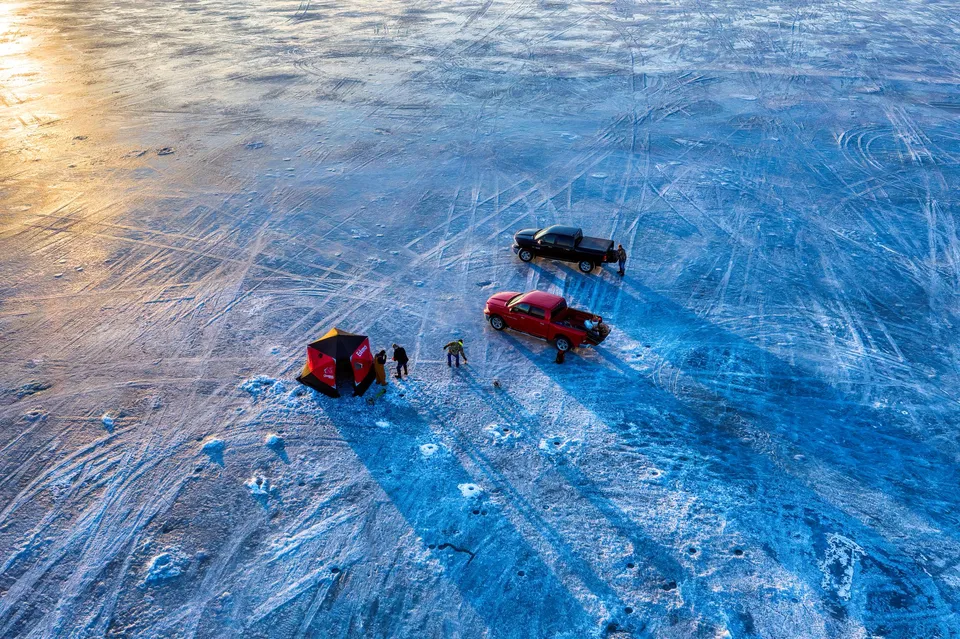
The clearest way to understand Baudette is to follow the seasons on the Rainy River. Lake of the Woods Tourism describes spring and fall Rainy River fishing, summer boating and fishing, and winter ice fishing. Those are not just tourism categories. They are evidence that the river changes the town’s pace across the year. Lake of the Woods Tourism on the Rainy River
Spring and fall matter because they are transition seasons, and the river becomes one of the main reasons people pay attention to them. Summer brings boating and fishing, which shifts the focus from cold-weather endurance to open-water movement. Winter, naturally, turns the same water into a different kind of destination through ice fishing. The point is not merely that outdoor recreation exists here. The point is that the same community supports several different versions of it, and each version changes who is in town, what they are doing, and how they use local space.
That seasonal variety helps explain why Baudette feels busier in the mind than it looks on the map. A town with one annual rhythm can seem easy to summarize. Baudette resists that. The river keeps redefining what “normal” means.
Why that matters for residents and newcomers
For residents, the advantage is obvious: local life does not have to be squeezed into one generic pattern. There is a place for camping, a place for a border view, and a place that carries the town’s fish-and-river identity in public. That spread gives people options for where to meet, where to bring visitors, and where to think about the town beyond the errand run.
For newcomers, the value is even more immediate. If you arrive expecting one dominant downtown experience, Baudette will probably surprise you. Its most useful public spaces are not all trying to serve the same purpose. One helps you stay over. One helps you orient yourself geographically. One helps you understand the town’s personality. That is a useful pattern to notice early, because it keeps you from asking the wrong question about the place.
Instead of asking, “Where is the one big thing?” a better Baudette question is, “What job do I need this place to do today?” In one season, that may mean a campground. In another, it may mean a park with a border view. At another point, it may mean a public place where the town’s fishing identity is easy to feel. Baudette is at its best when you let the setting match the reason for the visit.
The simplest way to read Baudette
Think of Baudette as a town of functions, not just labels. Highways 11 and 172 put it on the move. Lake of the Woods and the Rainy River anchor it in water. The city parks give it places to gather, notice, and stay. The tourism seasons show how the same shoreline can support spring, summer, fall, and winter without becoming repetitive.
That combination is why Baudette keeps rewarding a second look. The town is not trying to be everything at once. It just happens to have separate places for separate needs, and a calendar that makes those needs change over time. If you notice that, the rest of the town starts to make more sense.
If you are comparing jobs or hiring needs tied to the Baudette area, you can call 218-WorkNow or email the office to talk through verified options.