
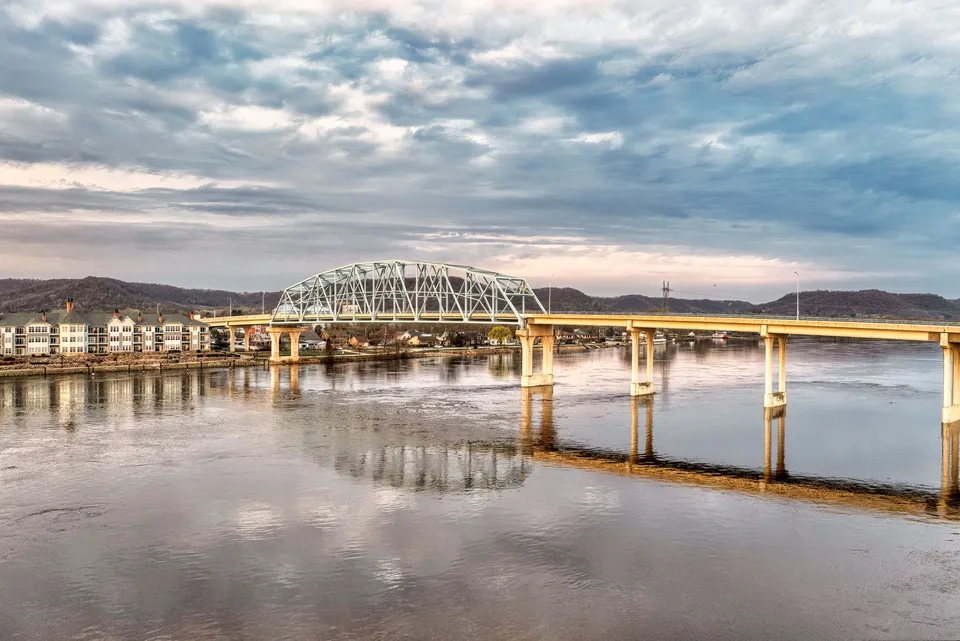
Baudette is the kind of town that makes more sense once you stop looking for a single main street. The official City of Baudette site places the city on Highways 11 and 172, just south of Lake of the Woods, and it describes three municipal parks that do different jobs: Timber Mill Community Park, Peace Park, and Bay Front Park. Peace Park is where you can look toward Canada and the International Bridge, while Bay Front Park is home to Willie the Walleye. That mix tells you something important right away: Baudette is organized around water, border movement, and public gathering, not around one commercial strip.
The bridge is not just a crossing
In a place like Baudette, a bridge is part of daily life, not a background detail. MnDOT’s Baudette / Rainy River International Bridge project says the replacement bridge was celebrated in 2020, and the project background material describes the older crossing as carrying about 1,350 vehicles a day. That matters because it shows the river crossing is not only symbolic; it is a working piece of transportation and border access. When people talk about Baudette as a border town, this is the reason: the river is both a boundary and a route.
The practical payoff is simple. If you live here, visit often, or are just planning a stop, you are not dealing with a town that grew away from the river. You are dealing with one that was built to face it. That changes how you think about errands, recreation, and even how you picture “downtown.” The crossing is part of the town’s core identity, not a feature at the edge of it.
The parks do different work
Baudette’s parks are worth noticing because they are not interchangeable. Peace Park gives you a view across the river toward Canada and the international crossing, which makes it useful for orientation as much as for leisure. Bay Front Park carries the town’s most recognizable mascot, Willie the Walleye, and that gives the waterfront a civic personality instead of a generic one. Timber Mill Community Park adds a different function again: the city says its campground offers RV and primitive camping, which makes it a practical in-town base for people who want to stay close to Baudette without pretending the whole experience has to be a resort stay.
That difference matters for newcomers and repeat visitors alike. Some towns have parks that mostly mean “green space.” Baudette’s parks are more like public tools. One helps you understand the border setting. One anchors the town’s signature identity. One gives you a place to camp close to services. The town’s public spaces are doing the work of orientation, memory, and overnight logistics all at once.
The seasons change the meaning of the river
Baudette is also easier to understand when you look at the river by season instead of by postcard. Lake of the Woods Tourism describes spring and fall Rainy River fishing, summer boating and fishing, and winter ice fishing on the same corridor. In other words, the river is not a one-season attraction. It keeps changing its use, and the local calendar changes with it. The same stretch of water can mean a quiet shoulder-season fishing trip, a summer launch point, or a winter destination with a completely different pace. Lake of the Woods Tourism makes that seasonal variety explicit.
That helps explain why Baudette resists a simple label. Calling it only a summer town misses the spring and fall fishing pattern. Calling it only a winter destination misses boating season. Calling it only a border crossing misses the way local life keeps circling back to the river for recreation, gathering, and movement. The more accurate view is that Baudette lives on a seasonal rhythm, and the river is the clock.
The county seat is part of the town’s identity
Baudette is not just a recreation base; it is also the county seat, and that shapes everyday life in a way visitors can miss. Lake of the Woods County places its government center at 206 8th Ave SE in Baudette, and the county’s directory shows how many core services are centralized there: assessor, auditor/treasurer, court administration, emergency management, land and water, recorder, social services, sheriff, and public works. That means Baudette functions as a practical hub for the county, not merely as a scenic stop on the way to the lake.
For residents, that concentration matters because it changes where you go when you need answers. For newcomers, it is a useful reminder that local life may involve county offices more often than city hall. In a small community, the county seat is not an abstract title; it is part of how the town works from day to day.
What to notice first
If you want a quick read on Baudette, start with three questions: where do people cross, where do they gather, and where do they handle public business? The bridge answers the first one, the parks answer the second, and the county government center answers the third. Put those together and Baudette stops looking like a dot on the map and starts looking like a small place with a very clear pattern. It is a town shaped by water, season, and service, with each part reinforcing the others.
That is the local discovery worth keeping in mind. Baudette’s best features are not separate attractions sitting side by side. They are connected pieces of the same civic landscape. The bridge tells you why the border matters. The parks tell you how people gather. The county center tells you how life gets organized. If you understand those three things, you understand a lot more about Baudette than a quick drive-through ever could.
If you are comparing jobs, services, or a move into the area, those same places can help you read the town faster. And if you want to explore verified local opportunities or discuss a hiring need, you can call 218-WorkNow or email the office.