
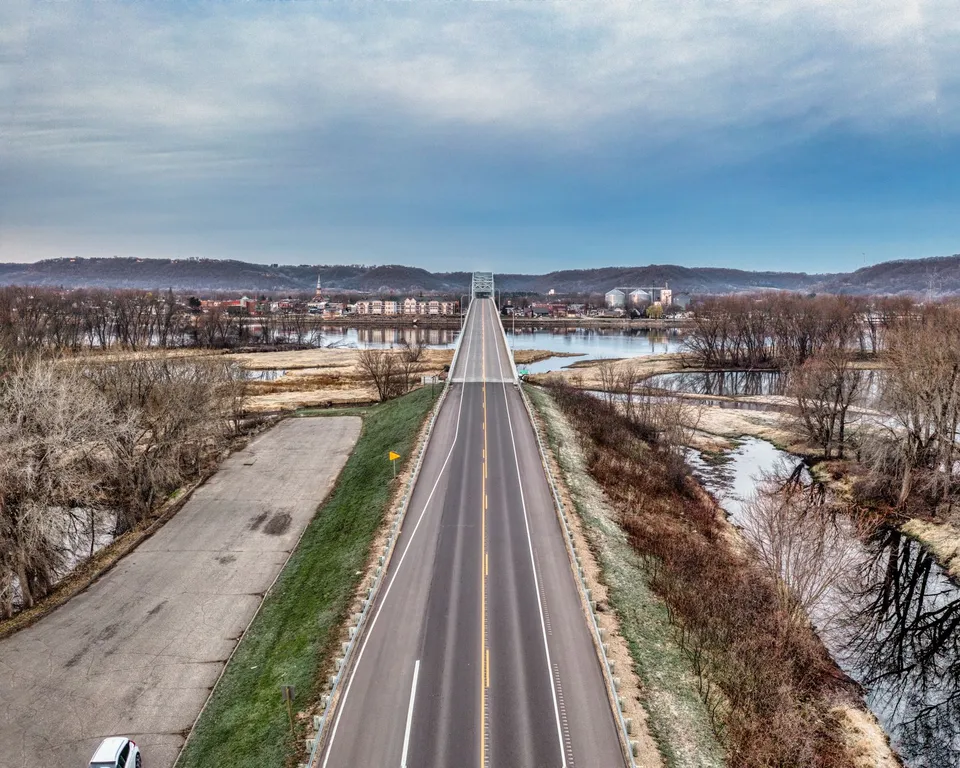
Baudette makes more sense when you stop treating it like a single dot on the map and start reading it as a town of gateways. One gateway is government: the Lake of the Woods County Government Center sits in Baudette at 206 8th Ave SE, and the county’s core offices are centered there. Another is the border crossing: the Rainy River International Bridge links Baudette to Rainy River, Ontario. The third is the waterfront public space around the city’s parks, where local identity becomes visible rather than bureaucratic. Together, those three places explain far more about daily life than any generic description of a small northern town.
Government is part of the town’s daily geography
Because Baudette is the county seat, county business is not abstract or far away. The county government center in town anchors offices for assessor, auditor/treasurer, court administration, emergency management, land and water, IT/GIS, recorder, social services, sheriff, and public works. That matters for residents and newcomers because a lot of the practical questions that shape a week in Baudette do not begin with a storefront or a coffee shop; they begin with county services, records, or permits. The county’s live directory and online functions reinforce that point: this is a place where public administration is woven into the town itself, not tucked somewhere outside it.
That county-center reality also helps explain why Baudette’s scale feels compact without feeling incidental. The city sits south of Lake of the Woods and is identified with Highways 11 and 172, which gives it a practical role in the local road network. For a small community, that kind of location is not just geography; it is how people reach offices, parks, shops, and the rest of the county. The town works because its public functions are placed where people already move.
The bridge is not just infrastructure
The Rainy River International Bridge gives Baudette a different kind of gateway. MnDOT identifies it as the crossing between Baudette and Rainy River on Minnesota Trunk Highway 72 and Ontario Highway 11, and the agency says the replacement bridge was completed in 2020. The bridge’s role is broader than transportation alone. It supports the border relationship between the two communities and helps define Baudette as a place where international geography is part of ordinary life.
That detail changes how a reader should picture the town. In many places, a bridge is simply a way over water. In Baudette, the bridge is part of the town’s public identity and part of the mental map residents use every day. Peace Park’s view toward Canada and the International Bridge makes that connection explicit: the bridge is not hidden in the background of local life, it is one of the sights that tell you where you are.
The parks are not leftovers
Baudette’s three municipal parks each do a different job. The city lists Timber Mill Community Park, Peace Park, and Bay Front Park, and that lineup is worth noticing because it shows how small towns organize public space around actual uses. Peace Park offers views of Canada and the International Bridge. Bay Front Park is home to Willie the Walleye. Timber Mill Community Park includes RV and primitive camping, which makes it a useful lodging-adjacent resource without turning the whole city into a resort. These are not decorative green spaces; they are working pieces of the town’s identity.
Willie the Walleye adds another layer. He is more than a mascot pasted onto a postcard. He signals that Baudette sees itself as a place shaped by water, fishing, and recurring public traditions. The city’s own pages tie Willie to Bay Front Park and to community recognition, which means the park is doing civic work as well as recreational work. For visitors, that matters because it tells you where the town chooses to welcome people. For residents, it says which places are meant to carry local memory.
Baudette’s seasons are part of its public logic
The town’s geography makes more sense when you look at it through the year instead of through a single month. Lake of the Woods Tourism describes spring and fall Rainy River fishing, summer boating and fishing, and winter ice fishing. That pattern helps explain why Baudette’s spaces need to be flexible. A bridge crossing, a county office, a campsite, and a park all serve different reasons to be in town, but they also all sit inside a seasonal rhythm that changes what people need from the same streets and shorelines.
This is where Baudette’s value becomes easy to miss if you only look for one headline feature. A summer visitor may think first about boating or fishing. A resident may think about county paperwork or school errands. A winter traveler may care about ice conditions and how the town still functions when recreation shifts forms. Baudette handles all of those roles because it is built around water, border access, and county services at the same time. The point is not that the town does one thing well; the point is that it keeps several useful jobs in one compact place.
What a newcomer or visitor can learn from that
If you are new to Baudette, the most useful mental model is simple: start with the place that matches the reason you are there. If the matter is official, the county center matters first. If you are crossing, the bridge matters first. If you are trying to understand the town’s public character, the parks matter first. That is a better reading of Baudette than trying to force it into a single category like fishing town, border town, or county seat. It is all three, and the town’s best public spaces make that clear.
And if you are thinking about the local job market, the same lesson applies: the strongest communities are usually the ones where public life is legible. Baudette’s bridge, parks, and county center show a town whose daily systems are easy to find and easy to explain. That kind of clarity is good for residents, good for visitors, and good for employers trying to understand how local life really works. If you want to talk about verified openings or a hiring need in the area, you can call 218-WorkNow or email the office.