
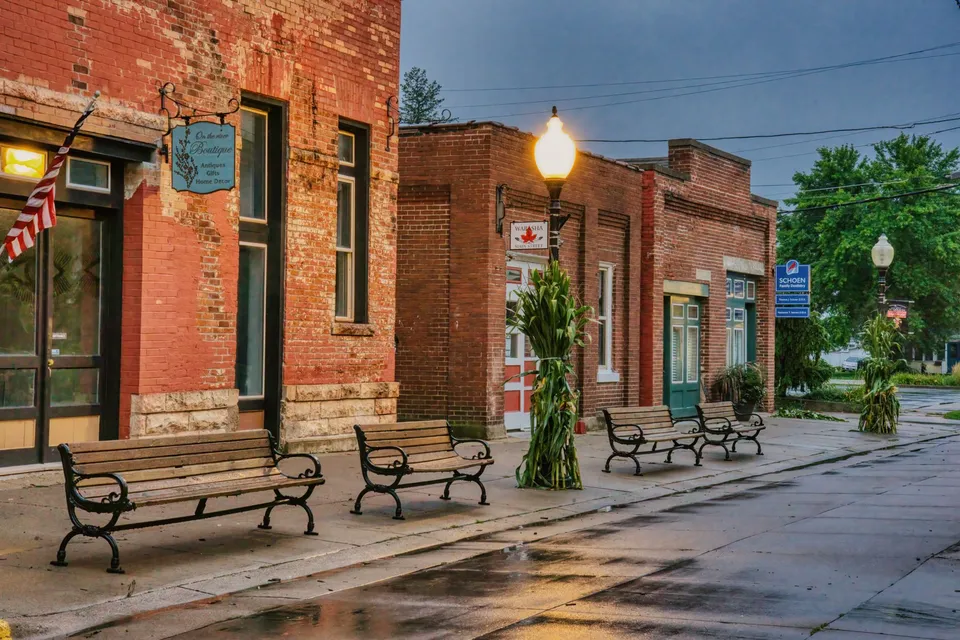
In Baudette, the most useful places are not all packed into one downtown block. The city sits south of Lake of the Woods on Highways 11 and 172, and the practical map of town life is built from public places that do different jobs: the city office, the county government center, the library, the parks, and the museum. That mix helps explain why Baudette feels larger in function than its size might suggest.
Three parks, three different purposes
Baudette’s official city pages list three municipal parks: Timber Mill Community Park, Peace Park, and Bay Front Park. Those names are not just decorative. Peace Park is the place the city points to for views of Canada and the International Bridge, so it works as a border overlook as much as a green space. Bay Front Park is home to Willie the Walleye, which ties a civic symbol to a real public setting instead of leaving it on a logo or brochure. Timber Mill Community Park adds another function, because the city also notes a campground there with RV and primitive camping. Together, the parks show that Baudette uses public land for orientation, identity, and recreation all at once.
That matters because Baudette’s public spaces are doing more than giving people somewhere to sit. They help a newcomer understand where the town points, what it values, and how it presents itself. A place with a border view, a mascot park, and a campground is telling you that local life is connected to water, travel, and visitors—not just to ordinary neighborhood routines. The city’s own self-description as the Walleye Capital of the World makes that identity even clearer.
The county seat does the heavy lifting
Baudette is also the county seat, and that changes the way the town works. The city office is at 106 Main Street W, while the Lake of the Woods County Government Center is at 206 8th Ave SE. Those are different places for a reason: city life and county life are not the same thing, even though both are centered in Baudette. The county directory shows a broad list of services tied to the government center, including assessor, auditor/treasurer, court administration, emergency management, land and water, recorder, social services, sheriff, and public works.
For residents, that means many practical questions are answered locally rather than in some faraway regional office. For newcomers, it is a reminder that Baudette is not just a place to pass through on the highway. It is where you go when you need the paperwork side of life to happen. That is a quiet but important distinction, because it explains why the town has a heavier civic role than its scale suggests.
The library is a real access point, not a side note
Small towns often talk about libraries as community treasures, but Baudette’s numbers show that the building is doing practical work. In the Baudette Public Library annual report, the Minnesota Department of Education reported a legal service area population of 943, along with 8,225 visits, 312 reference transactions, and 778 public internet computer sessions in the year reported. Those figures make the library look less like an ornamental amenity and more like a shared access point for information and technology.
That matters in a county seat where people may need a place to look something up, use a computer, or get help with everyday questions. The building does not have to be large to matter. It only has to be used, and the report shows that it is. In a town like Baudette, that is exactly the kind of institution that helps a place feel stable without becoming noisy about it.
The museum keeps the town’s memory in view
The Lake of the Woods County Museum adds the history layer that ties these public places together. Its exhibits cover geology, natural history, fur trade, settlement, industries, communities, the 1910 fire, fishing, logging, agriculture, and tourism. That is a wide span, and it matters because it shows Baudette and the wider county as a place that has been rebuilt through multiple eras rather than frozen in one story.
The museum’s historic-site list also includes the Canadian National Railway Depot in Baudette, described by the historical society as one of only two remaining Canadian National depots in the United States. That detail gives the town’s public geography a deeper meaning. Some places simply mark where people go now. Others, like the museum and depot, explain why people kept coming here in the first place. Baudette has both kinds.
A border town is also a seasonal town
Baudette’s location south of Lake of the Woods and beside the Rainy River is not just scenic background. It shapes the town’s daily logic. The city’s parks, the international bridge view from Peace Park, and the bridge connection to Rainy River, Ontario all point to a community that is organized around water, movement, and the border. MnDOT identifies the Rainy River International Bridge as the crossing between Baudette and Rainy River, Ontario, and the replacement bridge was completed in 2020.
That border-and-water setting is why Baudette’s public places work so well as a guide to the town. The parks show how the city presents itself. The county center shows how services are delivered. The library shows how people get information. The museum shows how the place remembers itself. Put those pieces together, and Baudette stops looking like a dot on a map and starts looking like a community with a clear internal logic.
If you are getting to know the area, start with one park, one public office, and one civic building. That short route explains a lot about how Baudette works. And if you are also exploring verified jobs or have a hiring need, you can call 218-WorkNow or email the office.